
World War 2
1939 - 1945
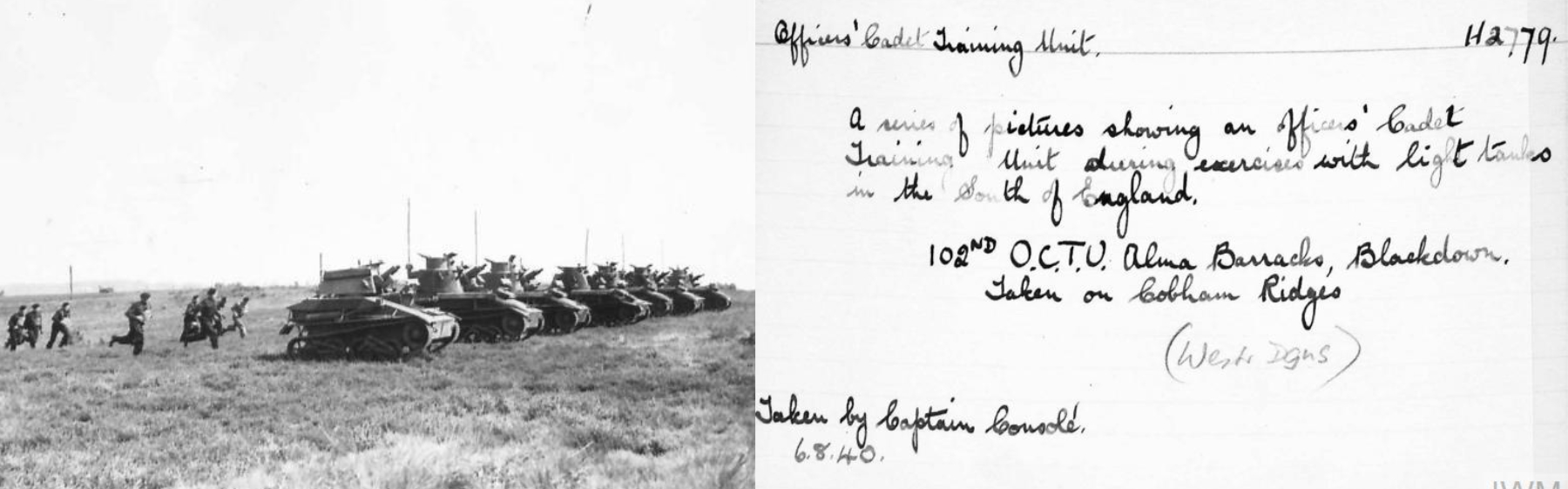
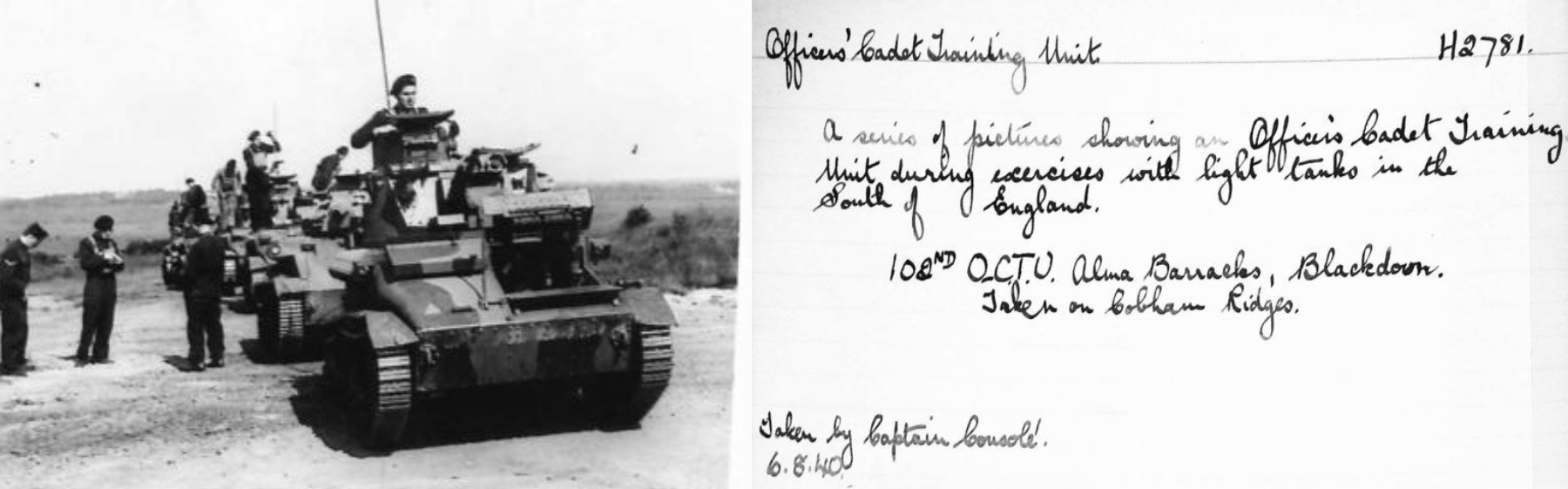
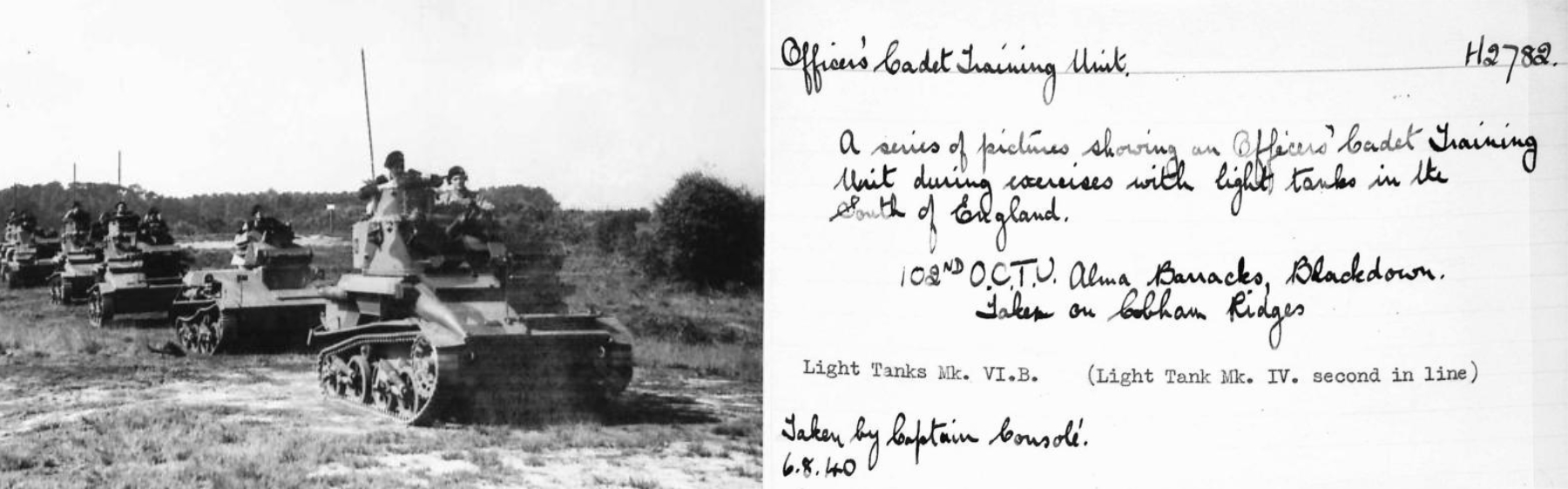
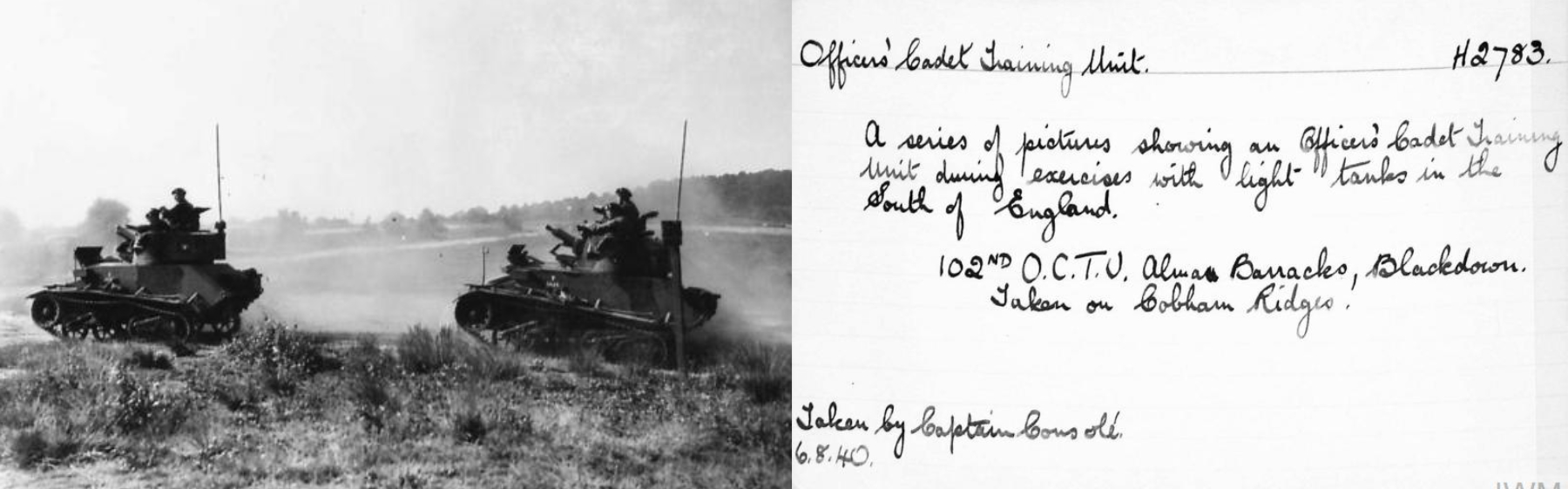
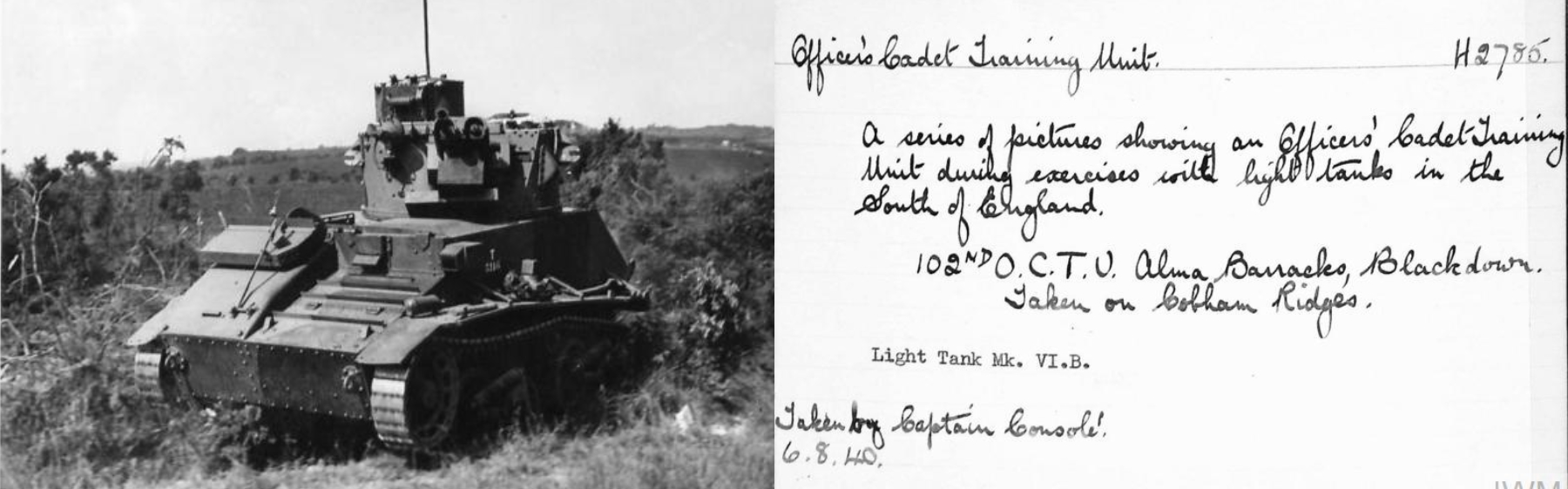
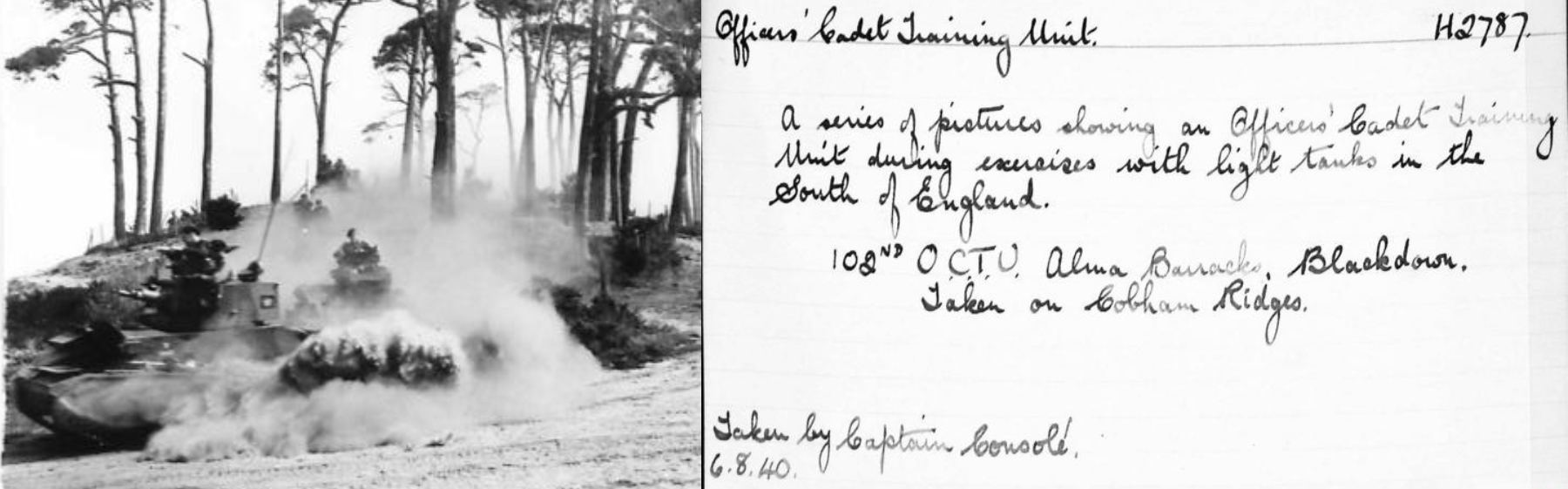
On mobilisation on the outbreak of war in 1939 the Regiment was ready and was immediately formed into the 102nd O.C.T. Unit (Officer Cadet Training Unit W.D.) at Blackdown, and for the next nine to 13 months continued with the task of training officers, these at first were mostly from its own members and later from the new intakes. Of the immediately late pre-war strength, over 90% of the regiment were commissioned, most to the R.T.R. and Yeomanry, and transferring into units throughout the British Army before the Regiment reverted to an armoured role in 1940.

The Armoured Car
However, from a long term point of view, the regiment's role as an O.C.T.U. was not very satisfactory so it was with great satisfaction that late in 1940 the regiment was reformed at Blackdown as an armoured regiment and styled the Westminster Dragoons (2nd County of London Yeomanry) R. A.C. with a cadre of about 10 officers and 15 O.R.'s under command of Lt/Col. A. ('Sailor') Willis R.T.R. (a Great War naval officer and a wonderful CO).
On 1 January 1944, then under the command of Lt-Col W.Y.K. Blair-Oliphant (Who led the regiment for the whole of the advance from Normandy to Germany).
The regiment moved to Thorpeness in Suffolk to begin flail training, the regiment had a mixed selection of tanks for training: Sherman V, Centaur, Cromwell, Valentine, Scorpions and Sherman Crabs.
Later two drafts of men joined, one from the 16/5 Lancers, and the other from the Queens Bays (2nd Dragoon Guards) to be followed shortly by recruits from London, Southampton and Bristol.
The Regiment was moved to Whitby and formed part of the 30th Armoured Brigade, 11th Armoured Division under Major General Hobart ('Hobo').
This brigade included the 1st Lothian Horse, 22nd Dragoons and 12 Kings Royal Rifle Corps. In the spring of 1942 this brigade joined the 42nd Armd Div. where training continued until November when it moved to Warminster in October 1943 and joined the 79th Armd Div.
This division was equipping with specialist armour nicknamed “Hobart’s Funnies” for the planned Allied invasion of Normandy “Operation Overlord”.
Hobarts Funnies
The Germans planted over four million mines and other defences along the French coast to hinder any Allied landings.
To break through these defences the British produced several novel armoured fighting vehicles, and the 30th Armoured brigade became the Flail tank brigade of the division.
Sherman Crab flails were the vehicles chosen for the task. These were specialised tanks with long lengths of chain attached to a rotating drum on the front of the tank for exploding mines and clearing a path, so began intensive training for the coming assault on Europe.
To ensure the success of such an operation, the equipment had to be specially evolved and the operating crews very highly trained in these techniques, having at the same time to fight their vehicles as tanks. Besides the flails other vehicles included — Duplex Drive swimming tanks, Bridging tanks, Fascine carriers, Petard tanks, Bobbin tanks.
Sherman DD (Duplex Drive)
Sherman DD (Duplex Drive) amphibious tank with waterproof float screens. When in the water the float screen was raised and the rear propellers came into operation. The Duplex Drive (DD) 'swimming' Sherman was an amphibious tank used on all five beaches on D-Day.
The duplex drive engine powered propellers in water and tracks on land. The canvas flotation screen gave the tank enough buoyancy to support its weight without having to sacrifice armour or firepower. Once ashore, the screes were dropped and the tanks became fully operational.
This allowed for a quick build-up of armour and provided almost immediate support for the invading infantry forces.
The Sherman ‘Crab'
The 'Crab' was a Sherman tank with a flail (roller and weighted chain) attachment used to clear mines.
The flail tank was not a new invention – the Matilda 'Scorpion' was used during the Battle of El Alamein in 1942 – but under Hobart's direction, the 'Scorpion' flail was adapted for use on the Sherman. Unlike on the 'Scorpion', the flail was powered by the tank's main engine.
Although heavily modified, the Sherman Crab retained the Sherman tank's firepower 75mm Gun and mobility, allowing it to defend itself while clearing mines. Its effectiveness saved countless lives and demonstrated the importance of specialist engineering vehicles in modern warfare.
The Churchill AVRE
The Churchill AVRE (Armoured Vehicle Royal Engineers) was a modified Churchill tank designed to support assault operations by overcoming battlefield obstacles and destroying fortified positions.
Its most distinctive feature was the Petard spigot mortar, a powerful demolition weapon used to destroy bunkers, pillboxes and gun emplacements.
The AVRE could also be fitted with specialised equipment, including fascines, bridges and mine-clearing devices, allowing it to tackle a wide range of engineering tasks.
The Churchill AVRE played a vital role during the Normandy campaign and the advance across North West Europe, providing the mobility, protection and firepower needed to help Allied forces break through heavily defended positions.
The Churchill Bobbin
The Churchill Bobbin was a modified Churchill AVRE designed to lay reinforced matting across soft sand and unstable beach surfaces. This created a temporary roadway capable of supporting the weight of tanks, vehicles and other heavy equipment during amphibious landings.
Developed for the D-Day landings, the Bobbin enabled Allied forces to move quickly inland by providing a stable route across terrain that would otherwise have trapped or delayed armoured vehicles. It was one of several ingenious engineering vehicles that helped ensure the success of the Normandy invasion.
The Churchill Fascine Carrier
The Churchill Fascine Carrier was a modified Churchill AVRE designed to carry and deploy fascines, large bundles of wooden sticks used to fill trenches, anti-tank ditches and other gaps. Once released, the fascine created a stable crossing, allowing tanks and other vehicles to continue their advance.
First introduced during the First World War, tank-carried fascines remained an effective solution for overcoming battlefield obstacles and played an important role in the Allied advance across North West Europe.
The Churchill Small Box Girder (SBG)
The Churchill Small Box Girder (SBG) Bridge Layer was a modified Churchill AVRE equipped to rapidly deploy a bridge over obstacles encountered during an assault. It could span gaps of up to 30 feet or provide a ramp to overcome walls up to 15 feet high.
Used extensively on D-Day and throughout the Normandy campaign, the SBG bridge was often employed alongside fascines to create safe routes for advancing armour.
Together, they enabled Allied forces to overcome anti-tank ditches, sea walls and other defensive obstacles with speed and efficiency.

Task / Format, B & C Squadrons Gold Beach
The task of B and C squadrons with 81 and 82 squadrons of 6 assault regiment Royal Engineers was to make gaps or lanes through the obstacles on and behind the beaches. Through these gaps 69 and 231 infantry brigades and the other supporting tanks guns etc would proceed to their further task inland. Obviously, these gaps had to be made before anything else could happen. B & C squadrons and 81 and 82 squadrons therefore were some of the first tanks to land.
To carry out their tasks the squadrons were organised as follows, in King sector, La Riviere, half of C squadron and half of 81 squadron combined to form 2 composite squadron known as X & Z breaching squadron.
X breaching squadron was commanded by Major S.P.M Sutton, with Captain Davis RE as second in command.
Z breaching squadron was commanded by Major Thompstone, RE with Captain R.F bell as second in command.
The other Half of B squadron and 82 squadron RE in Jig Green sector, Le Hamel, combined to form:
-
W & Y composite breaching squadrons.
-
W breaching commanded by Major Elphinstone RE with Captain B Taylor as second in command.
-
Y breaching squadron was commanded by Captain H.P Stanyon with Captain J Leytham R.E. as second in command.
Each breaching squadron consisted of three breaching teams in C squadron these were numbered, and each team consisted of 6 tanks, 2 x Sherman Crab Flails, 1x AVRE Bobbin, 1x AVRE, 1x Fascine the final vehicle was either a AVRE bridge layer or a command tank. Each LCT (landing craft tank) was loaded in the right order so that the right equipment would disembark to complete the required tasks for each beach section.
After their initial tasks had been completed, the Bobbin & Roly-Poly tanks had further tasks on the beach. The tanks of B & C squadron were then to take the lead and flail lanes through the numerous minefields. The fascine AVRE’s were to follow them and lay their facines in the anti-tank ditch and anywhere else where they might be required. The S.B.G bridge layer was to be dropped across the anti-tank ditch at the point where it crossed the centre road on C squadrons front.
Task / Format, A Squadron
In May 1944 A squadron were ordered to provide 22 flails for one corps which were to be allocated as follows.
-
12 flails to the 27th Armoured Brigade to come under the comd of Major Clifford of the 22nd Dragoons and for the initial landing to be divided into two parties. 8 x flails under Major Wallace and 4 x flails under Captain Beaumont.
-
5 flails to 266 forward delivery squadron, 1st troop under Lt Don Ingram.
-
5 flails to C Squadron Canadian armoured delivery regiment, 3rd troop under Lt D S Squirrell and subsequently Lt A K Dick
A Squadron waterproofed their vehicles at Thorpeness in, Suffolk and proceeded from there by transporter to concentration areas as follows.
-
Major Wallace’s party to Bolney, Sussex with the Staffordshire Yeomanry.
-
Captain Beaumont's party and 1st troop to Petworth Sussex.
-
3rd troop to Gosport, Hants.
The remainder of A squadron under Captain P J S Squirrell and consisting of one crew from squadron HQ, the 5th roller troop and all the administrative personnel and vehicles, minus the squadron leaders Jeep with the driver and three fitters remaining behind in Thorpeness.
After about a week in the concentration areas, all parties moved to their marshalling area’s. On the 3rd of June Major Wallace’s party left their marshalling area at Stanmer park and embarked on Landing Craft Tanks (LCT’s) at Newhaven, 2 flails were allocated to each LCT and loading went very well particularly in view of the fact that crews had not carried out this manoeuvre before and this was completed by 20.00 hours.
4th June, the convoy of LCT's was to have sailed at 0800 hours but this was cancelled, probably due to the bad weather in the channel. In the late afternoon crews were ferried back to the marshalling area camps for a wash and hot meal returning on board about 2100 hours.
5th June, the convoy put out from Newhaven starting at 0800 hours and anchored outside for an hour or two, before sailing and was underway for the rest of the day. The sea was rather choppy and most of the men and officers felt seasick. Maps were issued during the evening when it was known that the operation was on.
Juaye Mondaye
From Brecy B&C squadrons were ordered to move to Juaye Mondaye about 5 miles South of Bayeux, the tanks moved on the evening of the 11th and arrived to find the place consisted of a small row of houses a church and a monastery all in very close country extremely near the Germans. The Colonel was commanding a mixed force consisting of a company of engineers two troops of anti-tank guns, 1 platoon of medium machine guns, and his own 2 depleted squadrons. This force was under the command of 231 Brigade in 50th division and was to hold the hill about 6 hundred yards South of the village.
The battle in the area drew further away and on the 15th of June, A sqdn came over from 1 corps front. The real village of Juaye Mondaye lay about half mile to the north and this was only a kind of suburb which the locals refer to simply as Mondaye. South of the road was the Monastery and church, to the north a row of about a dozen villas and several large crumbling farms of grey stone. The Echelon trucks came up and the mixed force settled in a field alongside a row of houses. In the nearest house RHQ was set up together with an officer’s mess. Here in the fields of Mondaye during June and July where it became a kind of regimental base from which squadrons went out when they were required for operations and to which they could come back for rest and refit.
A combined action of B and C squadrons at La Belle Epine on the evening of the first day the regiment arrived at Mondaye. This composite sqdn was ordered to assist the 2nd Devons who had been repulsed from La Belle Epine and the task was to support the 2nd Devons back into the village. The sqdn arrived at the form up area just before dusk and in the failing light it was impossible to distinguish any definite enemy points. It was therefore decided the objective was only some 300 to 400 hundred yards from the start line and the flails were to be used as ordinary gun tanks this would bring maximum fire to bear on the village and all the hedges and likely enemy held positions. The attack was successful, and no casualties were incurred by either B or C sqdns
June the 17th; the regiment was ordered to provide tank support for the 2nd Battalion the Hampshire regiment of 231 brigade any attempt to capture the villager La Senaudiere some 2 miles to the South of point 112. Six flails of C sqdn commanded by Lt’s Holborn and Pear were dispatched for this purpose. The force moved to the form up area of the village of Bernieres Bocage, in support of A Company, the left-hand leading company, at that time only one platoon strong, owing to mechanical failures eventually only four tanks crossed the start line. All went well at first and an advance of 1000 yards was made; several casualties being inflicted among the enemy infantry by fire from the tanks. After pushing through a thick hedge Lt Pear’s tank was engaged at close range by an enemy anti-tank weapon, later believed to have been a dug in tank. Lt Pear ordered the crew to bail out after the tank have been hit twice and all members of the tank crew were wounded. Another tank, commander Cpl McCall believing that he had put the enemy gun out of action pushed through the same hedge and was in turn knocked out, the commander alone escaped.
Lt Hoban’s tank was meanwhile covering the infantry in their withdrawal from the woods to the north when he was told that there were two or three German tanks in the woods and whilst moving to a better fire position Lt Hoban’s tank was hit in the suspension and lost a track and had to be abandoned. Lt Pear and his crew having bowed out, a shell landed very close and driver Tpr Bromby, was seriously wounded and unable to walk any further. LT Pear although wounded himself ran back in the face of enemy machine gunfire to try and get a carrier though, this proved impossible and tpr Bromby had to be left behind and died of his wounds before he could be evacuated, the total number of casualties in the Regiment resulting from this section was 5 killed 4 wounded.
At the end of June C sqdn moved out for an attack on the “SS” held positions around St Mauvieu to make a break-through to the river Odon. The sqdn moved to Rucqueville and harboured alongside 9th R.T.R who had just arrived from England, after two days of planning they moved at night to just north of Secqueville-en-Bessin arriving in harbour at dawn, then at 2300hrs that night moved down to the start line for the attacks South of Norey-en-Bessin. The attack went forward steadily but slowly since the resistance of the “SS” troops was fierce and the return shelling very accurate. During the afternoon the Colonel and Padre Rhymes and Lt Sutton visited 2 and 3 troops and had to make a hurried exit chased by shells just before diving for cover in a sunken road the Padre was hit, fortunately nothing more than serious than a scratched knee. By 1700hrs St Mauvieu had been taken without any mine’s being met and the sqdn was ordered to place one-mile east St Mauvieu to support C squadron and 9th R.T.R. On arrival there and very short of petrol it is decided to remain on the start line and only go forward if required.
To the Seine and beyond
After nearly two months of bitter fighting during the build-up of men and materials the breakout from the bridgehead was just beginning when A Squadron finally moved out from Juaye Mondaye and made a night march to join the Seventh Armoured Division. The dust and darkness made visibility extremely bad and towards dawn a halt was made for a few hours near Torteval. Then after some breakfast the march was continued in dense traffic as far as shell shattered Caumont in what had been until recently the American sector. Here the squadron harboured in an apple orchard near the headquarters of Seventh Armoured Division for three days until moving on with the advance of 5th Inniskilling Dragoon Guards at first light on 5th August towards Maisoncelles Pelvey. Lt. Bullock's tank flailed a short distance at Le Bauquet and during the next few days the squadron advanced with the Seventh Armoured Division as the breakout all along the front was gaining momentum. A small bridgehead had been established" over the River Orne north, though as it happened the flails were not required, but. were sufficiently far forward to be shelled and had one man wounded. Two days later the squadron followed up the battle under command of 53 Division and swung south from the Foret de Cinglais towards Falaise. While the famous gap was being closed round the entrapped German forces A Squadron spent a week harboured at a farm a few miles west of Falaise itself and then rejoined the Regiment at Gace after a long march.
Three days later A Squadron moved to Brigade workshops near the town of Orbec for a routine overhaul of all the tanks and remained there until it joined the regiment once more and crossed the River Seine at Vernon on 2 September on route for Domeliers.
After moving from Juaye Mondaye the Squadron was placed in support of the 50th (Northumbrian) Division. For the attack the Squadron was divided into two halves. The right half was allotted to 56 Infantry Brigade and consisted of No. 3. Troop and later No. 1. Troop. The left half consisted of No. 2. Troop and was allotted to 231 Infantry Brigade. No. I. Troop was in reserve for the first few hours of the attack. Nos. 2 and 3 Troops were each in turn divided into halves. Lt. Hubble commanded half of No. 2. Troop and Lt. Robinson the other half. The halves of No. 3. Troop were commanded by Lt. Bright and Lt. MacKichan. Major Sutton commanded the right half, and Captain McMillan the left half. By the evening of the 29th July Lt’s. Bright and MacKichan had each joined battalions of 56 Infantry Brigade and Lt’s. Hubble and Robinson were together with a Squadron of the 13/18 Hussars. After much study of maps and air photographs by candlelight all was set for the next day.
Lt. MacKichan with the right forward battalion of 56 Infantry Brigade was to flail a track for carriers and other infantry vehicles up to the present front line. This was successfully carried out, and Lt. MacKichan was then asked by the Infantry to engage a Spandau machine-gun that was holding them up. He went up a track ahead of the infantry to do this but after advancing some fifty yards his tank struck a mine. He tried to reverse but promptly struck another mine, and the combined effect of these two mines cracked the bottom of the tank, wrecked the tracks and made it immovable. Attempting to bale out the crew were promptly engaged by Spandau fire from close range. The infantry were still twenty-five yards behind and unable to advance. The enemy were about twenty-five yards in front. The tank was stranded in no-mans-land.
Thus began an ordeal that lasted for five and a half hours. Lt. MacKichan and his crew used their 75mm gun and then Browning machine-gun, Sjt. Birch and Cpl. Savory in their tanks attempted to come forward to the relief of the knocked-out tank but were unsuccessful. Any attempt by infantry to approach the tank was promptly stopped by close range enemy fire, but eventually an attack was successful and Lt. MacKichan and his crew were relieved. Lt. Bright and the other half of No. 3. Troop was with the left forward battalion of 56 Infantry Brigade and were not required until about mid-day. At this time, they went forward to the village of Torteval from which the infantry was proposing to advance to the St. Germain D'Ectot Caumont road. They were soon held up by suspected mines and by Spandau fire. Lt. Bright and his half troop therefore did some flailing and engaged the areas suspected to contain the Spandau machine guns. The infantry then advanced successfully up to the road.
Further to the left No. 2. Troop was advancing in support of a Squadron of the 13/18th Hussars. The first incident occurred on the start line when the flail of Sgt. Steele's tank was damaged by shell fire, then at 6 p.m. orders came through to split into half troops and for each half troop to support an infantry company in a further advance. After a few hundred yards the infantry were held up by Spandau fire and suspected mines. Flailing failed to set off any mines but some shooting by Lt. Hubble and Cpl. Nicholls settled the Spandaus and the infantry occupied their objective. In the meantime, the other half of No. 2. Troop under Lt. Robinson's command were having an unpleasant time. They had been joined by a troop of Crocodiles (flame-throwing tanks). Their line of advance took them up a very narrow lane through the centre of a wood. The infantry was held up near a bomb crater in the middle of the wood. As they attempted to go round the crater the infantry suffered casualties from antipersonnel mines. Lt. Robinson then called up the crocodiles to assist in removing the casualties. This entailed a great deal of manoeuvring and eventually failing light caused the attack to be postponed. Finally, Lt. Robinson and his tanks had to reverse back down the track up which they had come. Throughout this time the tank commanders were being sniped at by hidden riflemen.
Early next morning Lt. Bright's half of No. 3. Troop found themselves taking- part in an attack on St. Germain D'Ectot. They flailed across a meadow, up a lane and through an orchard. The country was quite unsuitable for flails and the sight of them smashing their way through hedges and uprooting small trees was a fearsome one. They were followed by a troop of tanks from the 13/18 Hussars and a troop of AVRE. All these tanks engaged the village at close range and the infantry went in and captured it.
The objective for the next phase was the Launay Ridge. The attack was carried out by the 2nd Battalion of the Essex Regiment supported by an artillery barrage, machine-guns and mortars, a Squadron of tanks (the 13/l8th) and Nos. 1 And 3 Troops of C Squadron. The whole affair was arranged in extreme haste, and it was very satisfactory to see the attack take place entirely according to plan. There was slight trouble on the start line when some shells of the barrage fell rather short and startled No. 3. Troop. The matter was quickly put right, and once again the flails led the attack, but it was soon realised that there were very few mines about. As a result, the lanes so carefully made by Nos 1. and 3 Troops were little used. Lt. Hoban was told by an infantry officer to stop flailing because he was "making too much dust".
As dusk fell the flails were released and returned to the Squadron harbour. On the 2nd August the two halves of the Squadron re-united and joined 69 Infantry Brigade. Before the Squadron left 56 and 231 Infantry Brigades, Major Sutton and Captain McMillan were both warmly thanked by the Brigadiers for the support given by the flails during the three days.
When the Squadron arrived with 69 Infantry Brigade it was found that an attack was about to be launched and at 2 a.m. on Sunday morning, the 6th of August, the Squadron Leader was summoned from his bed to report at once to the headquarters of the 4th Armoured Brigade. But the Squadron did no fighting, and two days later moved 30 miles East to the village of La Toque where RHQ was already established.
It was now the 15th of August. The battle for the breakout from Normandy had been getting on for a fortnight. American armoured thrusts further West had made great strides and the possibility of a large German force being trapped; in the Falaise neighbourhood could, be foreseen by the most amateur strategists. People were thinking beyond Falaise, thinking of the road to Paris, of the liberation of all France, even of Victory.
It was therefore with great excitement that we heard that the 11th Armoured Division was to lead the British advance out of Normandy and that C Squadron was to go with them as their Squadron of flails. C Squadron joined the 11th Armoured Division on the 16th of August and for the next week moved 8 or 10 miles with them every day. On the 18th the Squadron passed through Flers and received a great welcome from the French. There was no doubting their joy at seeing us. Whenever the column stopped in the town each tank was at once surrounded by admiring French who shouted, waved; threw flowers and kisses, and produced Calvados. On the 22nd of August the Squadron was near Ecouche — only a few miles from Argentan. The battle of the Falaise gap was practically over and the advance was beginning to go extremely fast. Enemy mines had long since ceased to appear in any quantity. And so, to our great disappointment we were left behind and joined R.H.Q.’s, 8 Armd Bde and B Sqn were ordered that same evening to move south for an armoured advance on the following day. In failing light, the Squadron harboured south of Cahagnes amid a tangle of destroyed houses, dead cattle, wrecked vehicles and mines.
A twenty-four-hour delay occurred here and doubts as to a "Swan" were raised. But next day saw the Squadron on high ground to the south which in turn was dominated by Mount Pincon away to the left. The mountain had a detached and forbidding atmosphere about it and dominated the whole surrounding area to such an extent that one got the feeling that it was all a trap, and that camouflage was useless. After heavy fighting 8th Armoured Bde reached the top, the mountain was tamed, and all counter attacks successfully repulsed with heavy losses.
Across the Seine
Now followed a very hurried regrouping of forces to exploit to the limit the opening that had been started and which by now promised to become the awaited "swan". Major Buckingham took over command of B Squadron on the following day which was spent resting and sorting out the maps that had been arriving steadily for 24 hours until it was impossible to get any more into map boxes and bins'. The Squadron moved out after tea and joined 8th Armoured Bde, climbing the road over Mount Pincon again early next morning and so down into Le Plessis Grimoult where we had a first close view of an undamaged Royal Tiger.
Blown bridges were causing many detours by this time and wreckage was everywhere as the Falaise pocket was slowly compressed to the north. We were now rattling at full speed for Argentan, and as evening came on the weather became atrocious and without lights, in pitch darkness, the column advanced at a walking pace and finally stopped at about 0300 hrs, everyone dog tired and wet through. We had a brew up about 0700 hrs, and carried straight on, and reaching ruined Argentan where the Americans were hard at work clearing routes through the gardens, parks and any open space that was suitable.
The enemy were wide open, the Americans were nearing Paris, and it was vital that the Bde group should reach the Seine as quickly as possible. The “Swan” was on. In all villages and hamlets deserted by the enemy the local populace was lining the road waiting for us to arrive, and we were invariably greeted with flowers and fruit if on the move, and wine and eggs if we found an opportunity to stop. Gace, Laigle and Rugles were liberated in quick succession, but opposition was encountered in the wooded area between Rugles and Breteuil and caused a delay which was used to good advantage by the tanks while infantry cleared the wood.
The Seine was now only ten miles away but both men and tanks were tired out and filthy. The pace had been gruelling and sleep almost non-existent, but the infantry reached the river and crossed it against negligible opposition. While a bridge was being thrown across and rafts constructed everyone seized the opportunity to bring tanks up to fighting trim again, do personal laundry and have a good rest. The weather had been perfect, and everyone was complaining of sunburn, blisters and cracked lips. So much in the way of eggs, wine and fruits were showered on us everywhere that they became a major stowage problem. Maps were now in short supply. If you were lucky, you had a 1/100000 sheet, but the majority had only 1/250000 scale.
Rafting finally proved impracticable owing to marshy banks, but a bridge was constructed in record time with very little interference from the enemy. We crossed on 26th August and spent that night right on the riverbank north of the bridge, until the infantry had cleared the high wooded ground in front of us
The leading Squadrons of two Regiments together with one troop of flails were now across and Brigadier Prior-Palmer on his James two-stroke motorcycle became Brigade Tac HQ. We moved forward on to the high ground, and on 28th August the advance continued.
All real enemy resistance had now crumbled and even time bombs left by the retreating enemy did not deter the local population who turned out en masse and calmly ignored every explosion in the town. Against very slight opposition the high ground overlooking Beauvais was reached the same day and entered so early next morning that civilians were caught in bed and many became so excited that they forgot to dress and stood outside their houses in a variety of interesting creations!
As we neared the flying bomb sight area, however enemy opposition increased. It was hoped to reach Amiens on the 30th but darkness descended while we were still seven miles short, and we harboured and replenished the almost dry tanks, had our first hot meal of the day and snatched three hours sleep. Next morning it was decided to bypass Amiens which could be cleared by infantry and to try and reach Arras in one day. The river Somme was crossed at Dreuil-Les-Amiens where Brig Prior-Palmer by means of hand signals personally guided the leading group of tanks over a crazy wooden bridge which groaned and sagged but, to everyone's surprise, stood up to the strain.
White flags were seen in ever increasing numbers as small parties of Germans gave themselves up and passed back down the centre line. Beauval was rushed at top speed and the high ground overlooking Doullens reached in the early afternoon. It was here that the only heavy fighting took place, and in clearing enemy from the town it was reduced to a mass of blazing and wrecked buildings. To the amusement of the Sherwood Rangers, the flails were too wide to go through the arch in the centre of the village, of Lucheux but a way round was found, and we joined them at Sus-St-Leger in the early hours of the morning. Arras was still twelve miles ahead. Just as we were about to move off the next day, 1 Sep, orders were received that all special devices were frozen. Regretfully we saw the others^ move off then set about making ourselves comfortable and collecting the Squadron together. So the first “swan” came to an end.
B Squadron
On the 29th of the same month B Squadron rolled out the harbour again. This time to support 8th - Armoured Bde under command of 43 Inf Div, intention being to push forward as fast as possible in the direction of Mont Pincon. This was a. Corps attack, and on the right of 43 Div an attack was being launched by 15 (S) Div. The whole affair was, to be preceded by a heavy bombing of German tar-* gets.
On 43 Div front a limited attack was to be launched at H Hour with 2 troop of the Sqn, designed at forcing a bridgehead over a small stream some 1000 yards from the start line. As soon as this bridgehead was secured the weight of the attack was to be launched. At 0800 hrs on the 30th the attack to secure a bridgehead over the stream commenced. From the start the infantry found the going particularly difficult and there was heavy spandau and mortar fire. 2 troop flailed encountering very few mines, but unfortunately the troop leaders’ tank was blown up on a mine, and two members of the troop wounded by mortar fire while dismounted from the tank.
By the afternoon the attack had not secured a bridgehead, and as the attack by the 15 (S) Div had gone extremely well it was decided to exploit their success. The 13/18 H with 1 tp in support were despatched with infantry of 43 Div through the gap made by 15 (S) Div to attack the enemy opposite 43 Div from the rear. Although 1 tp were not required to do any flailing they had the satisfaction of claiming a number of enemy infantries killed, in an extremely successful attack.
Dormeliers
The tide of war swept on, too fast for the enemy to lay any mines, and the regiment halted until a stable front should form again. B Sqn who had been in the lead with 8th Armoured Brigade stopped near Lucheux. RHQ with A and C Squadrons moved in a separate column and harboured in two villages some twenty miles south of Amiens, C Sqn in Le Crocq and the rest in Dormeliers.
The sudden change from active service conditions was almost too much at first, and the Signals Officer and the R.T.A., immediately organized an attack on a farm where they had seen Germans through the window. The HQ fitter’s half-track, a formidable engine, armed with two aircraft Browning’s and a Bren attacked the farm, and the farmer rushed out begging for his life while the two Germans peacefully continued eating eggs in the kitchen. The Signals Officer sprang into the house and fell upon one of them, who had a pistol. The next day an excited Frenchman reported that there were several Germans armed with Tommy guns in a small copse near Dormeliers.
Two tanks of A Squadron bombarded the copse and the crews searched it on foot but found no Germans, dead or alive. Similar highly coloured and alarming reports of German activities were made by local inhabitants almost daily and without exception proved on investigation to be false or grossly exaggerated. Odd enemy stragglers were, however, collected from time to time during Our stay, but these always gave themselves up quite peaceably. To the villagers we were the first Allied troops they had seen and therefore liberators and they were extremely enthusiastic in their reception. Billeting was by invitation and many of us had a bed to sleep on for the first time since landing in France. The Second-in-Command had thoughtfully selected for RHQ Officers' Mess, a large house full of charming evacuees from Amiens. A great many of the local inhabitants were evacuated from Amiens and they were all very keen on parties.
A party might begin anytime, out of anything, and for no reason at all, and it very often did. Such celebrations were much assisted by consignments of champagne from Rheims, and Calvados, the local firewater, which is colourless except for a slight haze over the glass, like heat coming off a road in summer. Flies coming over too low were liable to be overcome by the fumes and fall in. Quite a lot of the regiment were overcome at first, but we all learnt to cope with it well enough to manage one glass, and it was found to work very satisfactorily in petrol lighters.
The first Sunday the village priest held a special Mass for the Liberation, and the Church was packed. A small muscular woman rang the bell as it had never rung before, beaming all over her face and whisking several feet in the air as the bell rope went up, a tremendous performance. The priest had organised the local F.F.L. and had kept the arms and ammunition in the loft of his Church. He had arranged the local resistance while visiting his flock and was a very excellent sort of man. He preached a tremendous fighting sermon and then led everyone out of the Church to sing patriotic songs and ended with the Marseillaise. The English then sang God Save the King, with tremendous applause from the French, and the priest who had a powerful growth of beard embraced the Commanding Officer on both cheeks.
The war was so far away by then that the Post Corporal was quite unable to get to the Brigade Post Office and back in one day, and we had two Post Trucks running in relays on alternate days. The Signals Officer erected a tremendous wireless mast, and the roars of the operators trying to contact Bde HQ nearly a hundred miles further away could be heard all over the village. In a few days we were training. One Troop Leader flailed a path of such accuracy and length that he felt compelled to draw attention to it. It lay, a neat brown line, straight across a large green field, to the professional eye it was a faultless lane.
Unfortunately, the Second-in-Command knew all about Agriculture, and it appeared that the green field was not grass, but lucerne. A new branch of training began the next day — the instruction of all officers in Crop recognition. In fact, we helped the farmers a great deal with transport and harvest parties, there being very little else to do, although officially it was illegal to use Army lorries for unmilitary purposes. The farmers were extremely grateful and refused to believe that payment was not expected.
There was one particularly embarrassing moment when the General arrived just as an aged farmer produced from a sack a huge goose and deposited it on the floor of the Adjutant's Office, followed by a shower of vegetables. After the first few day’s dances began. The French had their own method, which was a smart trot, entirely unrelieved by any subtleties, and performed to a continuous very fast foxtrot. It was not possible to do anything else to the tunes they played and when dances started later in Amiens or Arras, everyone jitterbugged. So, the Liberators found it all rather difficult but invariably fun.
Meanwhile the armoured advance finally stopped, and after nearly three weeks we moved north through Amiens to Lucheux and a fortnight later, through Belgium to Holland.
Subscribe to Newsletter
By subscribing, you consent to receive updates from our company and agree to our Privacy Policy.
Connect
© 2024 SaundersMedia. All rights reserved.